
References [ 5 ]
Hibberd DJ & Norris RE (1984) Cytology and ultrastructure of Chlorarachnion reptans (Chlorarachniophyta divisio nova, Chlorarachniophyceae classis nova). Journal of Phycology 20(2): 310-330.
Edvardsen B, Eikrem W, Green JC, Andersen RA, Moon-van der Staay SY & Medlin LK (2000) Phylogenetic reconstructions of the Haptophyta inferred from 18S ribosomal DNA sequences and available morphological data. Phycologia 39: 19-35.
DOI: none
Larsen A & Bryant S (1998) Growth rate and toxicity of Prymnesium parvum and Prymnesium patelliferum (Haptophyta) in response to changes in salinity, light and temperature. Sarsia 83: 409-418.
DOI: none
Edvardsen B, Eikrem W, Throndsen J, Saez AG, Probert I & Medlin LK (2011) Ribosomal DNA phylogenies and a morphological revision provide the basis for a revised taxonomy of the Prymnesiales (Haptophyta) European Journal of Phycology 46: 202-228.
Slocombe SP, Zhang QY, Ross M, Anderson A, Thomas NJ, Lapresa A, Rad Menéndez C, Campbell CN, Black KD, Stanley MS & Day JG (2015) Unlocking nature's treasure-chest: Screening for oleaginous algae. Scientific Reports 5: 09844.
DOI: 10.1038/srep09844
Division/Phylum: Haptophyta/Prymnesiophyta Class: Coccolithophyceae Order: Prymnesiales
Note: for strains where we have DNA barcodes we can be reasonably confident of identity, however for those not yet sequenced we rely on morphology
and the original identification, usually made by the depositor. Although CCAP makes every effort to ensure the correct taxonomic identity of strains, we cannot guarantee
that a strain is correctly identified at the species, genus or class levels. On this basis users are responsible for confirming the identity of the strain(s) they receive
from us on arrival before starting experiments.
For strain taxonomy we generally use AlgaeBase for algae and
Adl et al. (2019) for protists.
Culture media, purity and growth conditions:
Medium:
f/2;
Bacteria present; maintained by serial subculture;
| Attributes | |
| Authority | Green, Hibberd & Pienaar 1982 |
| Isolator | Hibberd (1976) |
| Collection Site | west end of the Fleet, Dorset, England, UK |
| Climatic Zone | Temperate |
| Notes | Clonal |
| Axenicity Status | Bacteria present |
| Area | Europe |
| Country | UK |
| Environment | Brackish |
| GMO | No |
| Latitude | SY 569839 |
| In Scope of Nagoya Protocol | No |
| ABS Note | Collected pre Nagoya Protocol. No known Nagoya Protocol restrictions for this strain. |
| Collection Date | c 1976 |
| Original Designation | DH189 |
| Pathogen | Not pathogenic: Hazard Class 1 |
| Strain Maintenance Sheet | SM_MarinePrymnesioHaptoChryso.pdf |
| Toxin Producer | Not Toxic / No Data |
| Type Culture | Yes |
| Taxonomy WoRMS ID | 246602 |
| Equivalent Strains | CCMP709,Plymouth 527 |
| Synonyms | Prymnesium parvum f. patelliferum (Green, Hibberd & Pienaar) Larsen 1999 |
| Formerly Listed in CCAP as | Prymnesium patellifera |
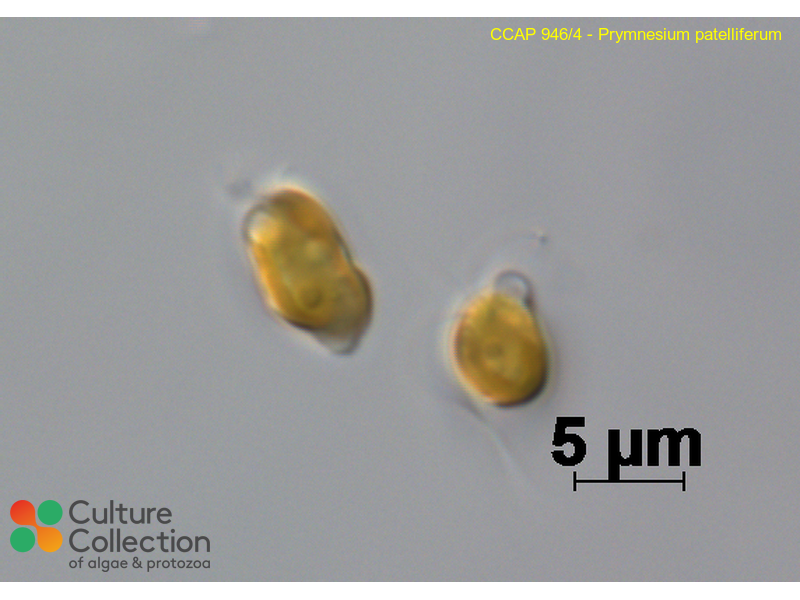
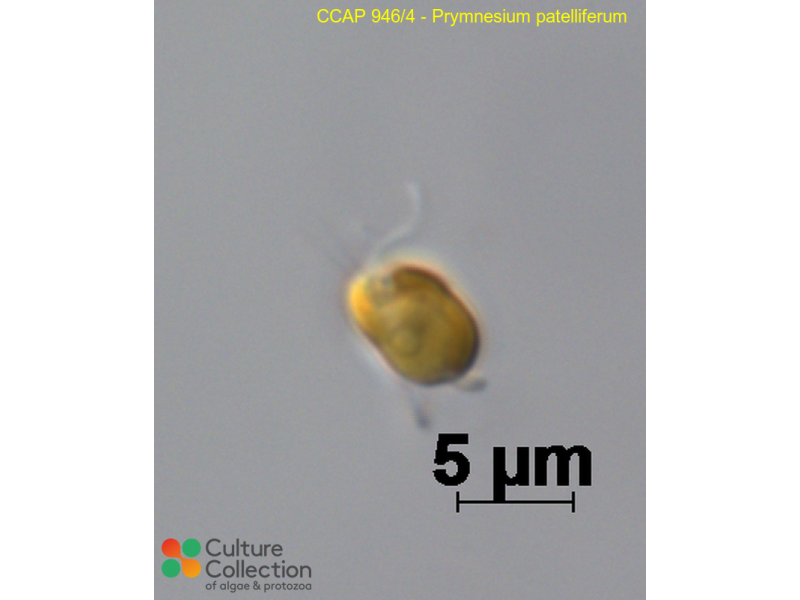
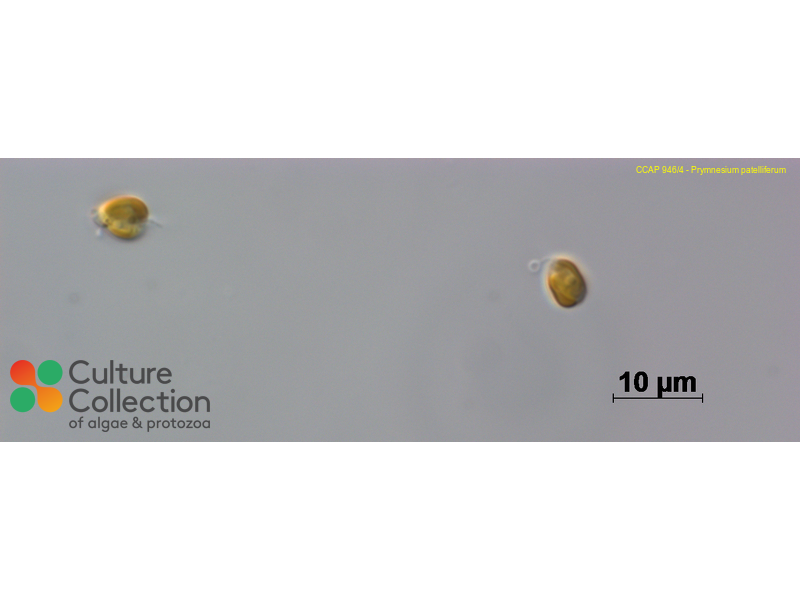
CCAP 946/4
Prymnesium patelliferum
- Product Code: CCAP 946/4
- Availability: See Availability/Lead Times