
References [ 3 ]
Hatton AD & Wilson ST (2007) Particulate dimethylsulphoxide and dimethylsulphoniopropionate in phytoplankton cultures and Scottish coastal waters. Aquatic Sciences - Research Across Boundaries 69: 330-340.
Wilson ST (2007) The production of biogenic gases in the marine environment. A Thesis presented for the degree of Doctor of Philosophy at the Open University -: 319 pp.
DOI: none
Weissbach A & Legrand C (2012) Effect of different salinities on growth and intra- and extracellular toxicity of four strains of the haptophyte Prymnesium parvum. Aquatic Microbial Ecology 67: 139-149.
DOI: 10.3354/ame01589
Sequences [ 1 ]
EMBL/Genbank Links
(Bold text = submission by CCAP staff or collaborators)
(Bold text = submission by CCAP staff or collaborators)
18S
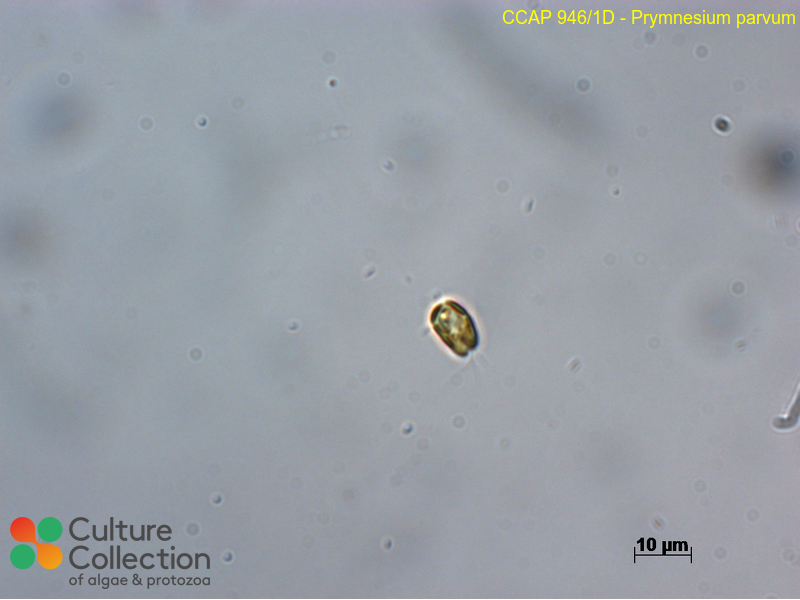
Division/Phylum: Haptophyta/Prymnesiophyta Class: Coccolithophyceae Order: Prymnesiales
Note: for strains where we have DNA barcodes we can be reasonably confident of identity, however for those not yet sequenced we rely on morphology
and the original identification, usually made by the depositor. Although CCAP makes every effort to ensure the correct taxonomic identity of strains, we cannot guarantee
that a strain is correctly identified at the species, genus or class levels. On this basis users are responsible for confirming the identity of the strain(s) they receive
from us on arrival before starting experiments.
For strain taxonomy we generally use AlgaeBase for algae and
Adl et al. (2019) for protists.
Culture media, purity and growth conditions:
Medium:
f/2;
Bacteria and other organisms present; maintained by serial subculture;
| Attributes | |
| Authority | N.Carter 1937 |
| Isolator | Reich (1953) |
| Collection Site | fish ponds Nir-David, Israel |
| Notes | Isolated via dilution and antiobiotics; Reinstated November 2014 from Plymouth Culture Collection. |
| Axenicity Status | Bacteria and other organisms present |
| Area | Asia |
| Country | Israel |
| Environment | Brackish |
| GMO | No |
| In Scope of Nagoya Protocol | No |
| ABS Note | Collected pre Nagoya Protocol. No known Nagoya Protocol restrictions for this strain. |
| Collection Date | c 1953 |
| Pathogen | Not pathogenic: Hazard Class 1 |
| Strain Maintenance Sheet | SM_MarinePrymnesioHaptoChryso.pdf |
| Toxin Producer | Not Toxic / No Data |
| Type Culture | No |
| Taxonomy WoRMS ID | 160564 |
| Equivalent Strains | Plymouth 94B |