
References [ 9 ]
Day JG (2004) Cryopreservation: fundamentals, mechanisms of damage on freezing/thawing and application in culture collections Nova Hedwigia 79: 191-205.
Day JG, Watanabe MM & Turner MF (1998) Ex situ conservation of protistan and cyanobacterial biodiversity : CCAP - NIES collaboration 1991 - 1997. Phycological Research 46: 77-83.
DOI: none
Day JG & Fenwick C (1993) Cryopreservation of members of the genus Tetraselmis used in aquaculture. Aquaculture 118: 151-160.
Peperzak L & Brussaard CPD (2011) Flow cytometric applicability of fluorescent vitality probes on phytoplankton Journal of Phycology 47: 692-702.
Gwo J-C, Twan W-H & Lin S-C (2023) Cryopreservation of six marine microalgae used in Taiwanese aquaculture. Journal of the World Aquaculture Society 54(5): 1235-1246.
DOI: 10.1111/jwas.12957
Herbert H, Parkes R, Barone ME, McDonnell A, Picciotto S, Adamo G, Paterna A, Manno M, Bongiovanni A, Touzet N & Campion E (2024) Antioxidant properties and bioactivity of three marine microalgae on human cancer cell lines Applied Phycology -: 1-17.
Conlon T, Aranyos A, Luck T & Touzet N (2024) The effects of trophic mode and medium composition on the biochemical profile and antioxidant capacity of Tetraselmis chuii (CCAP 66/21B) Biocatalysis and Agricultural Biotechnology 61: 103362.
Conlon T, Parkes R, Fierli D & Touzet N (2024) Comparative pigment and fatty acid profiling of marine species within the chlorophyte genus Tetraselmis Food Bioscience 58: 103660.
Conlon T, Herbert H, Campion E & Touzet N (2025) Bioactivity of autotrophic and mixotrophic Tetraselmis chuii (CCAP 66/21B) extracts against H2O2-mediated stress in A549 cells. Process Biochemistry 155: 117-127.
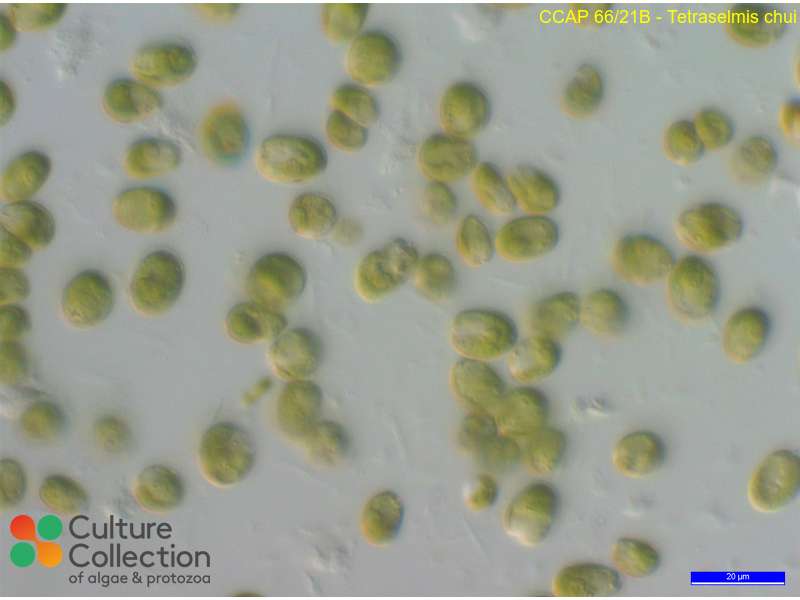
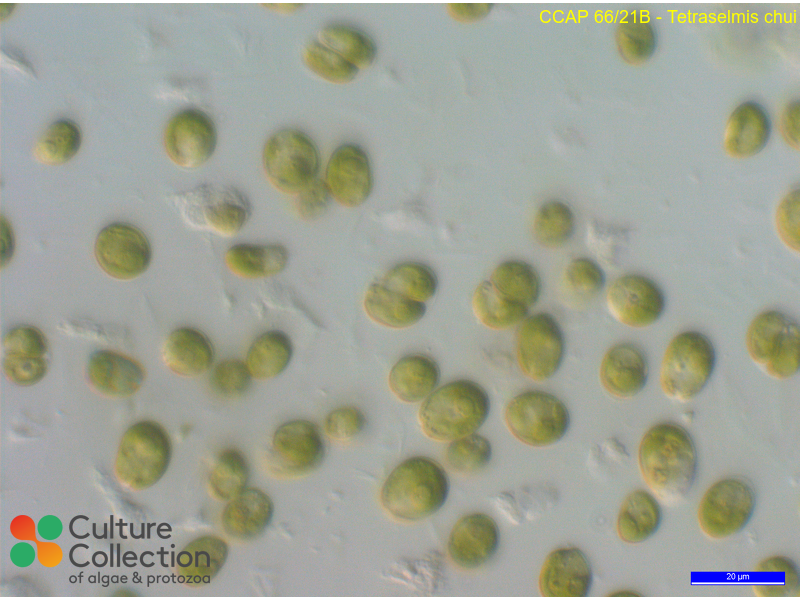
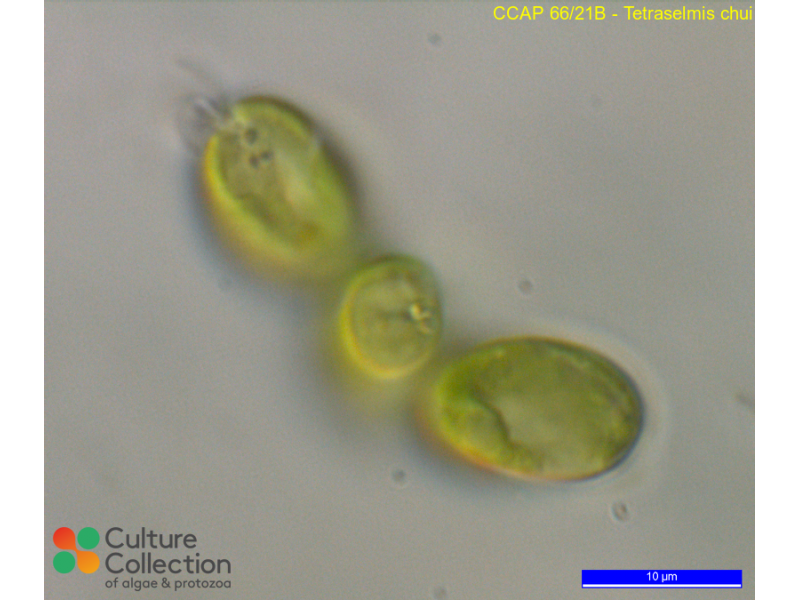
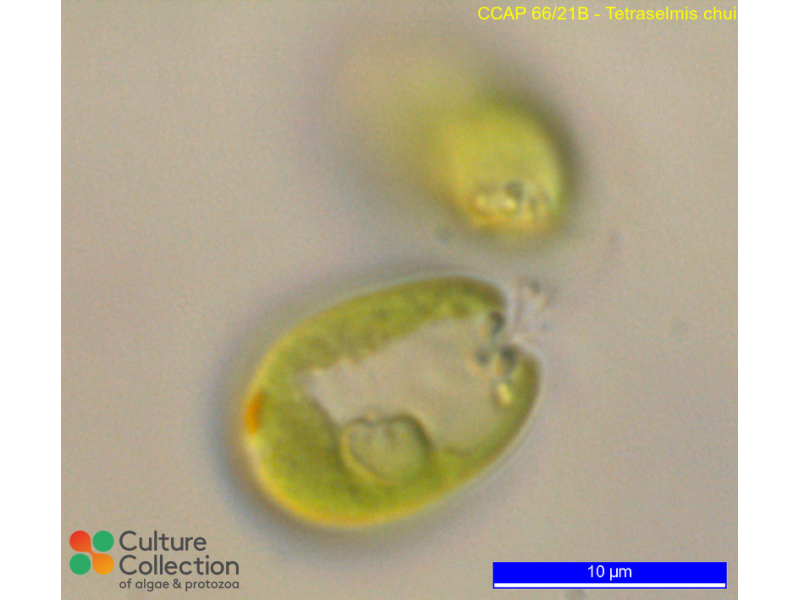
Division/Phylum: Chlorophyta Class: Chlorodendrophyceae Order: Chlorodendrales
Note: for strains where we have DNA barcodes we can be reasonably confident of identity, however for those not yet sequenced we rely on morphology
and the original identification, usually made by the depositor. Although CCAP makes every effort to ensure the correct taxonomic identity of strains, we cannot guarantee
that a strain is correctly identified at the species, genus or class levels. On this basis users are responsible for confirming the identity of the strain(s) they receive
from us on arrival before starting experiments.
For strain taxonomy we generally use AlgaeBase for algae and
Adl et al. (2019) for protists.
Culture media, purity and growth conditions:
Medium:
f/2 Quad;
Bacteria present; Cryopreserved;
| Attributes | |
| Authority | Butcher 1959 |
| Isolator | Butcher (1960) |
| Collection Site | Withernsea, Yorkshire, England, UK |
| Climatic Zone | Temperate |
| Notes | Isolation: pipetting; clonal; |
| Axenicity Status | Bacteria present |
| Area | Europe |
| Country | UK |
| Environment | Marine |
| GMO | No |
| In Scope of Nagoya Protocol | No |
| ABS Note | Collected pre Nagoya Protocol. No known Nagoya Protocol restrictions for this strain. |
| Collection Date | c 1960 |
| Original Designation | YKS3.BC 101/4 |
| Pathogen | Not pathogenic: Hazard Class 1 |
| Strain Maintenance Sheet | SM_MarineGreens.pdf |
| Toxin Producer | Not Toxic / No Data |
| Type Culture | No |
| Taxonomy WoRMS ID | 345528 |
| Equivalent Strains | CCMP883 |