
References [ 1 ]
Estermann AH, Pereira Bassiaridis JT, Loos A, Solbach MD, Bonkowski M, Hess S & Dumack K (2023) Fungivorous protists in the rhizosphere of Arabidopsis thaliana - Diversity, functions, and publicly available cultures for experimental exploration Soil Biology and Biochemistry 187: 109206.
Sequences [ 1 ]
EMBL/Genbank Links
(Bold text = submission by CCAP staff or collaborators)
(Bold text = submission by CCAP staff or collaborators)
SSU (18S)
Division/Phylum: Amoebozoa Class: Tubulinea
Note: for strains where we have DNA barcodes we can be reasonably confident of identity, however for those not yet sequenced we rely on morphology
and the original identification, usually made by the depositor. Although CCAP makes every effort to ensure the correct taxonomic identity of strains, we cannot guarantee
that a strain is correctly identified at the species, genus or class levels. On this basis users are responsible for confirming the identity of the strain(s) they receive
from us on arrival before starting experiments.
For strain taxonomy we generally use AlgaeBase for algae and
Adl et al. (2019) for protists.
Culture media, purity and growth conditions:
Medium:
WG (enquire);
Bacteria present; maintained by serial subculture; 10-20 deg C, pH 7, no lighting, feeds on Saccharomyces cerevisiae
| Attributes | |
| Authority | Penard 1902 |
| Isolator | Dumack (2018) |
| Collection Site | Brühl |
| Climatic Zone | Temperate |
| Notes | isolated via glass pipette, identified by 18S rRNA sequence |
| Axenicity Status | Bacteria present |
| Area | Europe |
| Country | Germany |
| Environment | Plant/Lichen |
| GMO | No |
| Group | Protozoa |
| Latitude | 50.827 |
| Longitude | 6.909 |
| In Scope of Nagoya Protocol | No |
| ABS Note | Collected post Nagoya Protocol from a country with no ABS measures at time of access. No known Nagoya Protocol restrictions for this strain. |
| Collection Date | July 2018 |
| Pathogen | Not pathogenic: Hazard Class 1 |
| Strain Maintenance Sheet | SM_Vampyrellids.pdf |
| Toxin Producer | Not Toxic / No Data |
| Type Culture | No |
| Synonyms | Cryptodifflugia operculata |
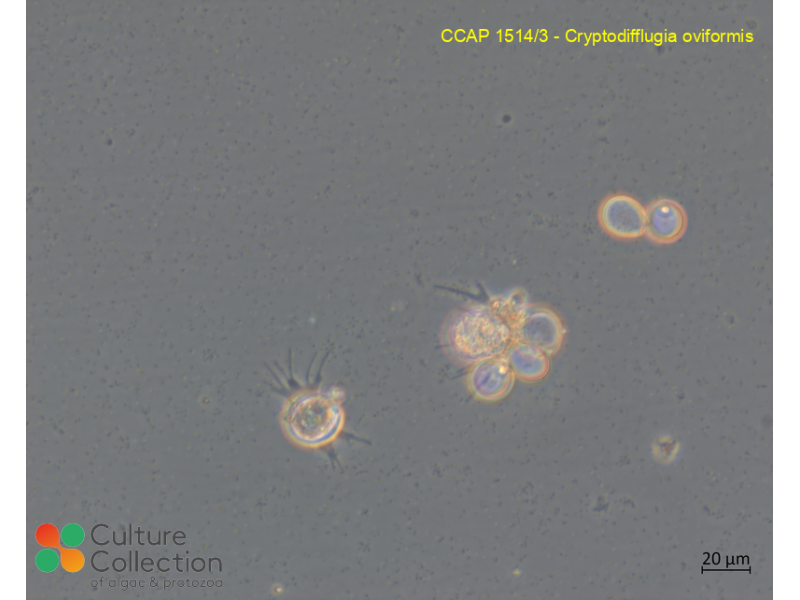
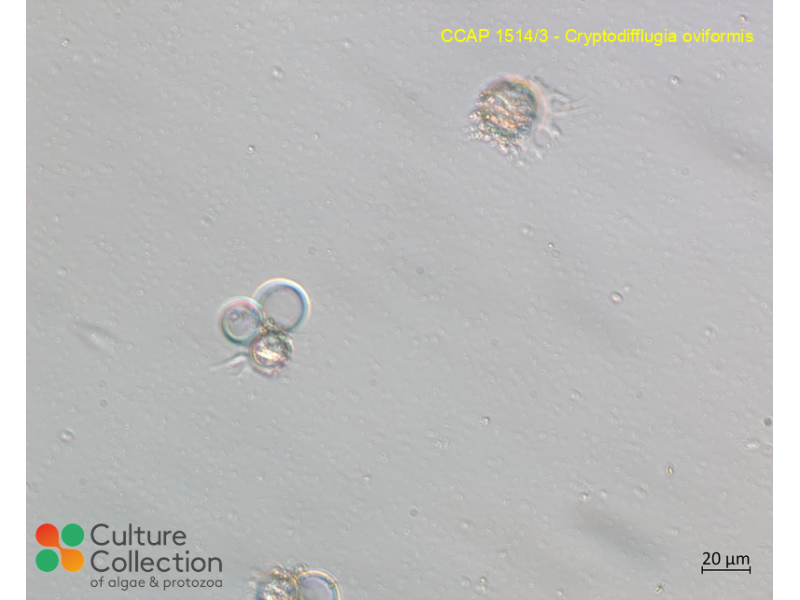
CCAP 1514/3
Cryptodifflugia oviformis
- Product Code: CCAP 1514/3
- Availability: See Availability/Lead Times