
References [ 1 ]
Corsaro D, Mrva M, Colson P & Walochnik J (2024) Validation and redescription of Acanthamoeba terricola Pussard, 1964 (Amoebozoa: Acanthamoebidae) European Journal of Protistology 94: 126091.
Division/Phylum: Amoebozoa Class: Discosea
Note: for strains where we have DNA barcodes we can be reasonably confident of identity, however for those not yet sequenced we rely on morphology
and the original identification, usually made by the depositor. Although CCAP makes every effort to ensure the correct taxonomic identity of strains, we cannot guarantee
that a strain is correctly identified at the species, genus or class levels. On this basis users are responsible for confirming the identity of the strain(s) they receive
from us on arrival before starting experiments.
For strain taxonomy we generally use AlgaeBase for algae and
Adl et al. (2019) for protists.
Culture media, purity and growth conditions:
Medium:
NN;
Monoxenic; Cryopreserved; contains E. coli as food source
Medium:
PYG;
Axenic; maintained by serial subculture;
| Attributes | |
| Authority | Pussard 1964 |
| Isolator | Pussard (1960) |
| Collection Site | arable soil, experimental park of French national agronomic institute Seine-et-Oise, near Paris, France |
| Notes | Isolation: cultivation on agar plate; identified by morphology and sequencing. Holotype; morphologically almost identical to A. castellanii, differs from A. castellani and other morphological group 2 species by unique sequence types of the nuclear rDNA operon, mitochondrial SSU and LSU rDNA, and cox1 fragment sequence signatures (Corsaro et al. 2024) |
| Axenicity Status | M,A |
| Area | Europe |
| Country | France |
| Environment | Soil |
| GMO | No |
| Group | Protozoa |
| In Scope of Nagoya Protocol | No |
| ABS Note | Collected pre Nagoya Protocol. No known Nagoya Protocol restrictions for this strain. |
| Collection Date | 1960 |
| Original Designation | Pussard-425 |
| Pathogen | Potential Pathogen: Hazard Class 2 |
| Strain Maintenance Sheet | SM_Acanthamoeba_Axenic.pdf |
| Toxin Producer | Not Toxic / No Data |
| Type Culture | Yes |
| Other Designations | ATCC 30134 |
CCAP 1501/20
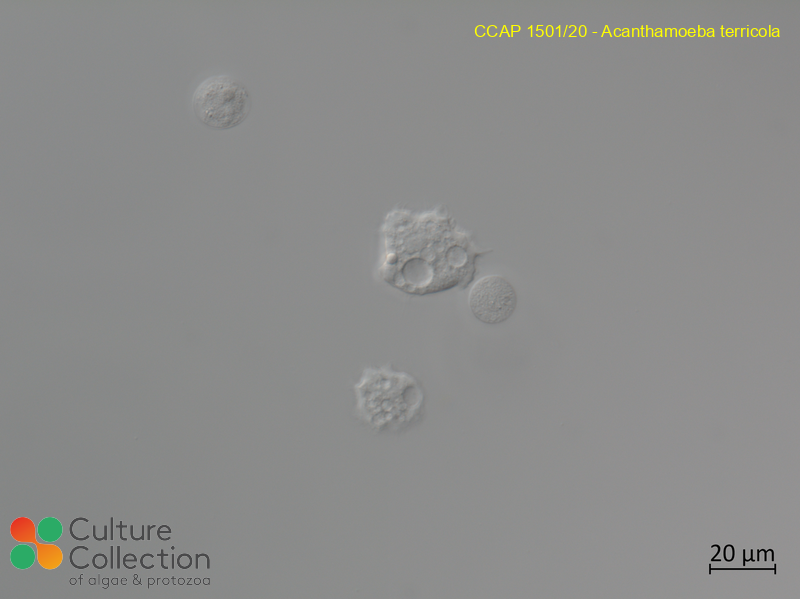
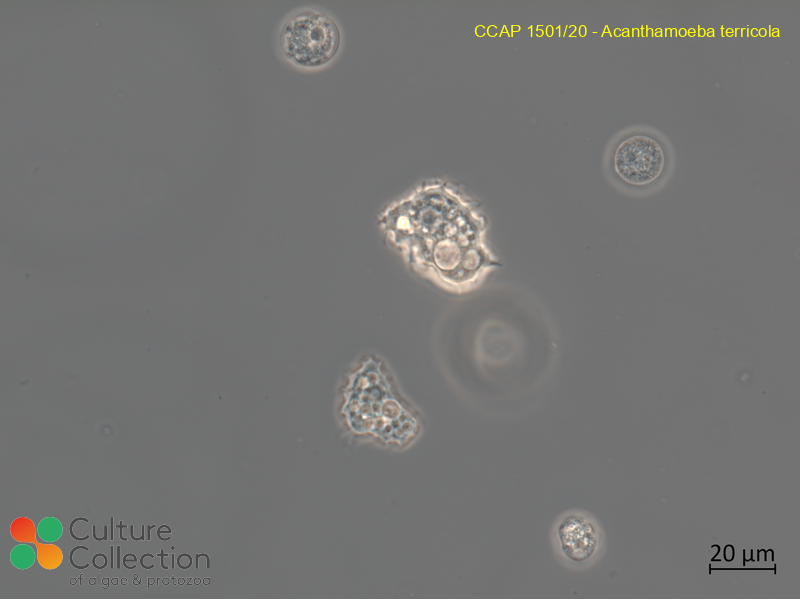
Acanthamoeba terricola
- Product Code: CCAP 1501/20
- Availability: Potential Pathogen
You are ordering Pathogenic strains - we cannot supply these via online ordering. Please contact CCAP directly. You will be required to download and submit Form A before any pathogenic strains are despatched.