
References [ 6 ]
De Martino A, Meichenin A, Shi J, Pan K & Bowler C (2007) Genetic and phenotypic characterization of Phaeodactylum tricornutum (Bacillariophyceae) accessions. Journal of Phycology 43: 992-1009.
He L, Han X & Yu Z (2014) A rare Phaeodactylum tricornutum cruciform morphotype: Culture conditions, transformation and unique fatty acid characteristics. PLoS ONE 9: e93922.
Dorrell RG, Drew J, Nisbet RER & Howe CJ (2014) Evolution of chloroplast transcript processing in Plasmodium and its chromerid algal relatives. PLoS Genetics 10(1): e1004008.
Stanley MS & Callow JA (2007) Whole cell adhesion strength of morphotypes and isolates of Phaeodactylum tricornutum (Bacillariophyceae). European Journal of Phycology 42: 191-197.
Lis H, Shaked Y, Kranzler C, Keren N & Morel FMM (2015) Iron bioavailability to phytoplankton: An empirical approach. The ISME Journal 9: 1003-1013.
Dorrell RG, Azuma T, Nomura M, Audren de Kerdrel G, Paoli L, Yang S, Bowler C, Ishii K, Miyashita H, Gile GH & Kamikawa R (2019) Principles of plastid reductive evolution illuminated by nonphotosynthetic chrysophytes. PNAS 116 (14): 6914-6923.
Sequences [ 1 ]
EMBL/Genbank Links
(Bold text = submission by CCAP staff or collaborators)
(Bold text = submission by CCAP staff or collaborators)
18S-28S
Division/Phylum: Heterokontophyta/Ochrophyta Class: Bacillariophyceae Order: Naviculales
Note: for strains where we have DNA barcodes we can be reasonably confident of identity, however for those not yet sequenced we rely on morphology
and the original identification, usually made by the depositor. Although CCAP makes every effort to ensure the correct taxonomic identity of strains, we cannot guarantee
that a strain is correctly identified at the species, genus or class levels. On this basis users are responsible for confirming the identity of the strain(s) they receive
from us on arrival before starting experiments.
For strain taxonomy we generally use AlgaeBase for algae and
Adl et al. (2019) for protists.
Culture media, purity and growth conditions:
Medium:
f/2 + Si;
Bacteria present; maintained by serial subculture and cryopreserved;
| Attributes | |
| Authority | Bohlin 1897 |
| Isolator | Guillard (1972) |
| Collection Site | Estuary, shallow tidal creek with widely ranging salinity West Dennis, Cape Cod Bay, Gulf of Maine, Massachusetts |
| Notes | Bowler & DeMartino Pt5; Name confirmed March 2013 (ASSEMBLE); |
| Axenicity Status | Bacteria present |
| Area | North America |
| Country | USA |
| Environment | Marine |
| GMO | No |
| Group | Diatom |
| In Scope of Nagoya Protocol | No |
| ABS Note | Collected pre Nagoya Protocol. No known Nagoya Protocol restrictions for this strain. |
| Collection Date | c 1972 |
| Pathogen | Not pathogenic: Hazard Class 1 |
| Strain Maintenance Sheet | SM_MarineDiatoms15_20.pdf |
| Toxin Producer | Not Toxic / No Data |
| Type Culture | No |
| Taxonomy WoRMS ID | 175584 |
| Equivalent Strains | CCMP630,NEPCC 738 |
CCAP 1055/2
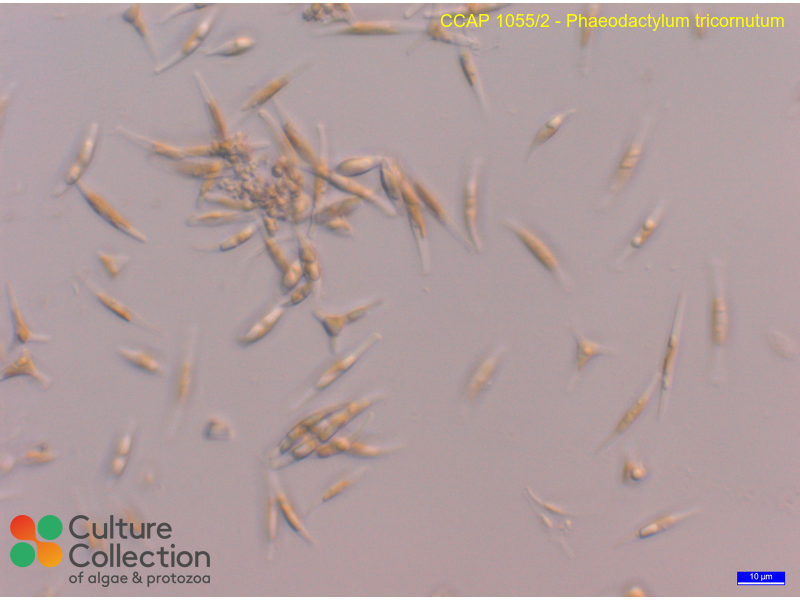
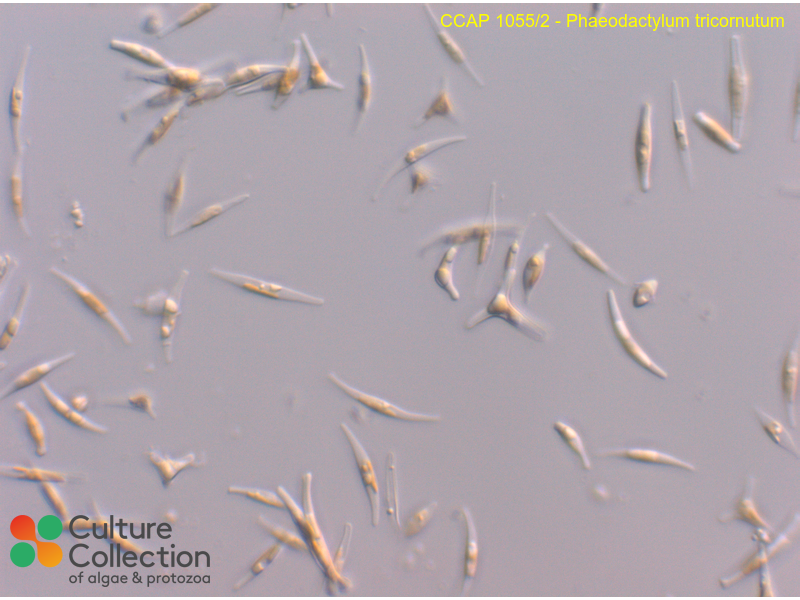
Phaeodactylum tricornutum
- Product Code: CCAP 1055/2
- Availability: See Availability/Lead Times