
References [ 8 ]
Borowitzka MA & Siva CJ (2007) The taxonomy of the genus Dunaliella (Chlorophyta, Dunaliellales) with emphasis on the marine and halophilic species. Journal of Applied Phycology 19: 567-590.
Assuncao P, Jaen-Molina R, Caujape-Castells J, de la Jara A, Carmona L, Freijanes K & Mendoza H (2011) Phylogenetic position of Dunaliella acidophila (Chlorophyceae) based on ITS and rbcL sequences. Journal of Applied Phycology 24: 635-639.
Santin-Montanya I, Sandin-Espana P, Garcia Baudin JM & Coll-Morales J (2007) Optimal growth of Dunaliella primolecta in axenic conditions to assay herbicides. Chemosphere 66: 1315-1322.
Assuncao P, Jaen-Molina R, Caujape-Castells J, de la Jara A, Carmona L, Freijanes K & Mendoza H (2012) Molecular taxonomy of Dunaliella (Chlorophyceae), with a special focus on D. salina: ITS2 sequences revisited with an extensive geographical sampling. Aquatic Biosystems 8: 2.
DOI: none
Emami K, Hack E, Nelson A, Brain CM, Lyne FM, Mesbahi E, Day JG & Caldwell GS (2015) Proteomic-based biotyping reveals hidden diversity within a microalgae culture collection: An example using Dunaliella. Scientific Reports 5: 10036.
DOI: 10.1038/srep10036
Slocombe SP, Zhang QY, Ross M, Anderson A, Thomas NJ, Lapresa A, Rad Menéndez C, Campbell CN, Black KD, Stanley MS & Day JG (2015) Unlocking nature's treasure-chest: Screening for oleaginous algae. Scientific Reports 5: 09844.
DOI: 10.1038/srep09844
Singh P, Khadim R, Singh AK, Singh U, Maurya P, Tiwari A & Asthana R (2018) Biochemical and physiological characterization of a halotolerant Dunaliella salina isolated from hypersaline Sambhar Lake, India Journal of Phycology -: -.
DOI: 10.1111/jpy.12777
Liu C, Huang D, Zhuo X, Feng J, Wen X, Liao Z, Wu R, Hu Z, Lou S & Li H (2023) Elevated accumulation of lutein and zeaxanthin in a novel high-biomass strain Dunaliella sp. ZP-1 through EMS mutagenesis. Biotechnology for Biofuels and Bioproducts -: -.
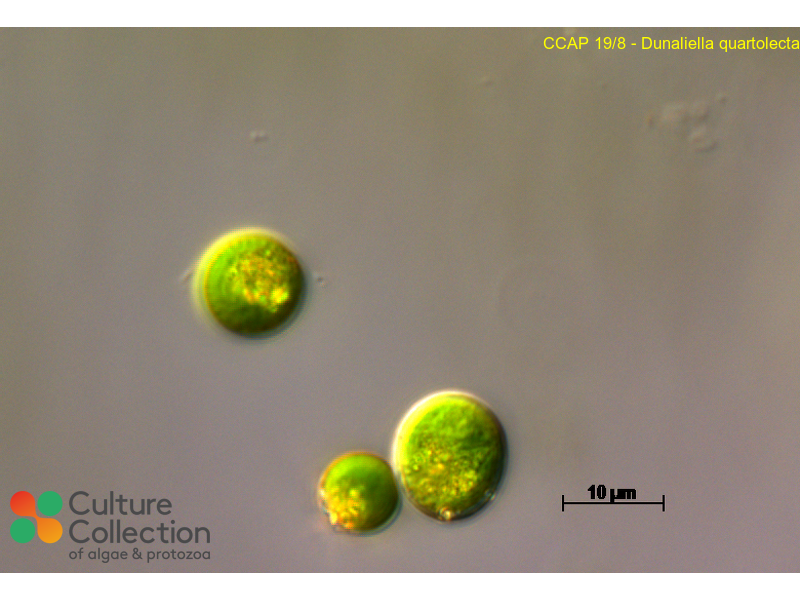
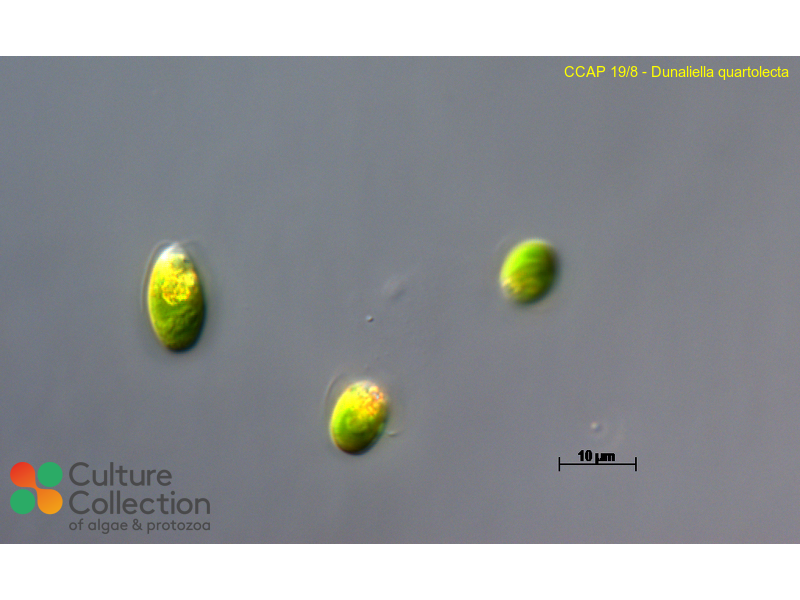
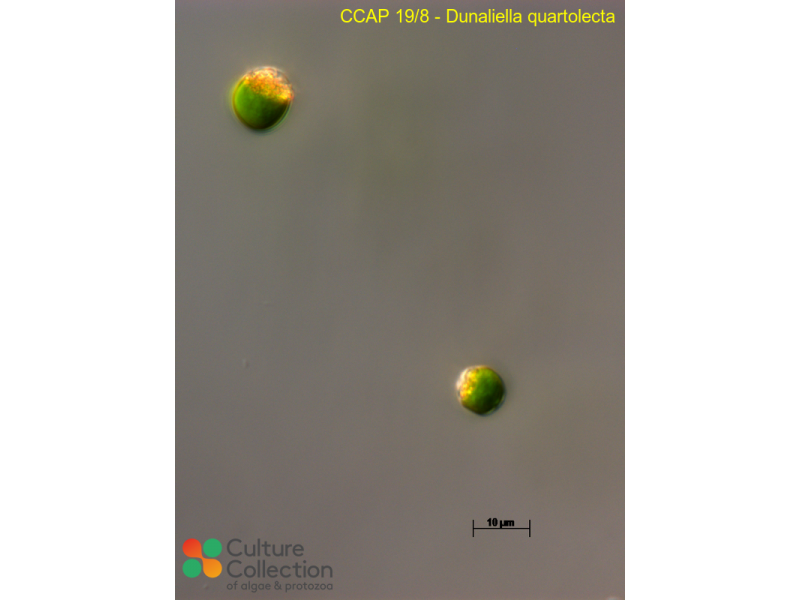
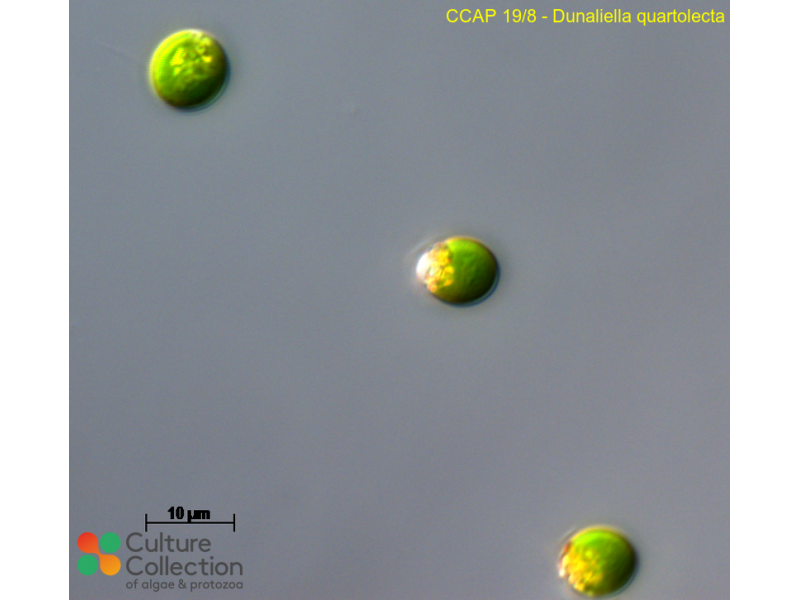
Division/Phylum: Chlorophyta Class: Chlorophyceae Order: Chlamydomonadales
Note: for strains where we have DNA barcodes we can be reasonably confident of identity, however for those not yet sequenced we rely on morphology
and the original identification, usually made by the depositor. Although CCAP makes every effort to ensure the correct taxonomic identity of strains, we cannot guarantee
that a strain is correctly identified at the species, genus or class levels. On this basis users are responsible for confirming the identity of the strain(s) they receive
from us on arrival before starting experiments.
For strain taxonomy we generally use AlgaeBase for algae and
Adl et al. (2019) for protists.
Culture media, purity and growth conditions:
Medium:
f/2 or f/2 Quad;
Axenic; maintained by serial subculture and cryopreserved;
| Attributes | |
| Authority | Butcher 1959 |
| Isolator | Butcher (1953) |
| Collection Site | Southampton, Hampshire, England, UK |
| Climatic Zone | Temperate |
| Notes | Isolation: pipetting |
| Axenicity Status | Axenic |
| Area | Europe |
| Country | UK |
| Environment | Marine |
| GMO | No |
| In Scope of Nagoya Protocol | No |
| ABS Note | Collected pre Nagoya Protocol. No known Nagoya Protocol restrictions for this strain. |
| Collection Date | c 1953 |
| Original Designation | (South).BC 47/5 |
| Pathogen | Not pathogenic: Hazard Class 1 |
| Strain Maintenance Sheet | SM_Dunaliella.pdf |
| Toxin Producer | Not Toxic / No Data |
| Type Culture | No |
| Taxonomy WoRMS ID | 616520 |