
References [ 6 ]
Assuncao P, Jaen-Molina R, Caujape-Castells J, de la Jara A, Carmona L, Freijanes K & Mendoza H (2011) Phylogenetic position of Dunaliella acidophila (Chlorophyceae) based on ITS and rbcL sequences. Journal of Applied Phycology 24: 635-639.
Ginzburg M & Ginzburg BZ (1981) Interrelationships of light, temperature, sodium chloride and carbon source in growth of halotolerant and halophilic strains of Dunaliella. British Phycological Journal 16: 313-324.
Assuncao P, Jaen-Molina R, Caujape-Castells J, de la Jara A, Carmona L, Freijanes K & Mendoza H (2012) Molecular taxonomy of Dunaliella (Chlorophyceae), with a special focus on D. salina: ITS2 sequences revisited with an extensive geographical sampling. Aquatic Biosystems 8: 2.
DOI: none
Emami K, Hack E, Nelson A, Brain CM, Lyne FM, Mesbahi E, Day JG & Caldwell GS (2015) Proteomic-based biotyping reveals hidden diversity within a microalgae culture collection: An example using Dunaliella. Scientific Reports 5: 10036.
DOI: 10.1038/srep10036
Hughes AH, Magot F, Tawfike A, Rad-Menéndez C, Thomas N, Young LC, Stucchi L, Carettoni D, Stanley MS, Edrada-Ebel R & Duncan KR (2021) Exploring the chemical space of macro- and micro- algae using comparative metabolomics Microorganisms 9: 311.
Hughes AH, Magot F, Tawfike AF, Rad Menéndez C, Thomas N, Young LC, Stucchi L, Carettoni D, Stanley MS, Edrada-EBel R & Duncan KR (2021) Exploring the chemical space of macro- and micro-algae using comparative metabolomics. Microorganisms 9: 311.
Division/Phylum: Chlorophyta Class: Chlorophyceae Order: Chlamydomonadales
Note: for strains where we have DNA barcodes we can be reasonably confident of identity, however for those not yet sequenced we rely on morphology
and the original identification, usually made by the depositor. Although CCAP makes every effort to ensure the correct taxonomic identity of strains, we cannot guarantee
that a strain is correctly identified at the species, genus or class levels. On this basis users are responsible for confirming the identity of the strain(s) they receive
from us on arrival before starting experiments.
For strain taxonomy we generally use AlgaeBase for algae and
Adl et al. (2019) for protists.
Culture media, purity and growth conditions:
Medium:
f/2 or f/2 Quad;
Axenic; maintained by serial subculture and cryopreserved;
| Attributes | |
| Authority | Butcher 1959 |
| Isolator | Butcher (1954) |
| Collection Site | River Crouch, Essex, England, UK |
| Climatic Zone | Temperate |
| Notes | Isolation: pipetting; Renamed after Assuncao et al. (2012) |
| Axenicity Status | Axenic |
| Area | Europe |
| Country | UK |
| Environment | Brackish |
| GMO | No |
| In Scope of Nagoya Protocol | No |
| ABS Note | Collected pre Nagoya Protocol. No known Nagoya Protocol restrictions for this strain. |
| Collection Date | c 1954 |
| Original Designation | RP.BC 47/7 |
| Pathogen | Not pathogenic: Hazard Class 1 |
| Strain Maintenance Sheet | SM_Dunaliella.pdf |
| Toxin Producer | Not Toxic / No Data |
| Type Culture | No |
| Taxonomy WoRMS ID | 178590 |
| Formerly Listed in CCAP as | Dunaliella polymorpha Butcher 1959 |
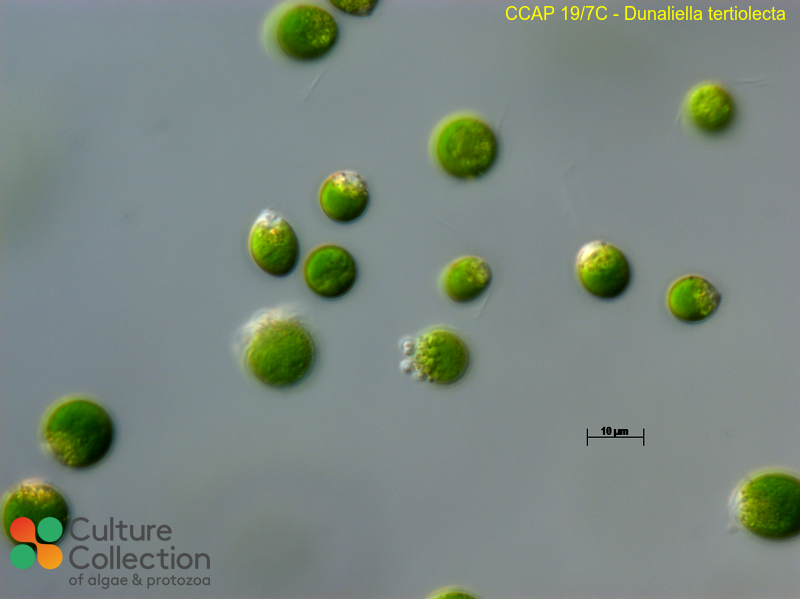
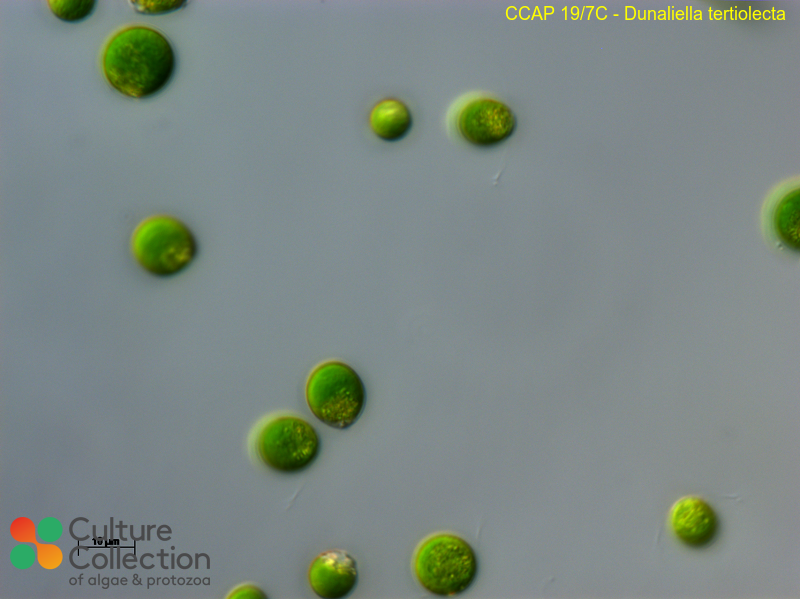
CCAP 19/7C
Dunaliella tertiolecta
- Product Code: CCAP 19/7C
- Availability: See Availability/Lead Times